
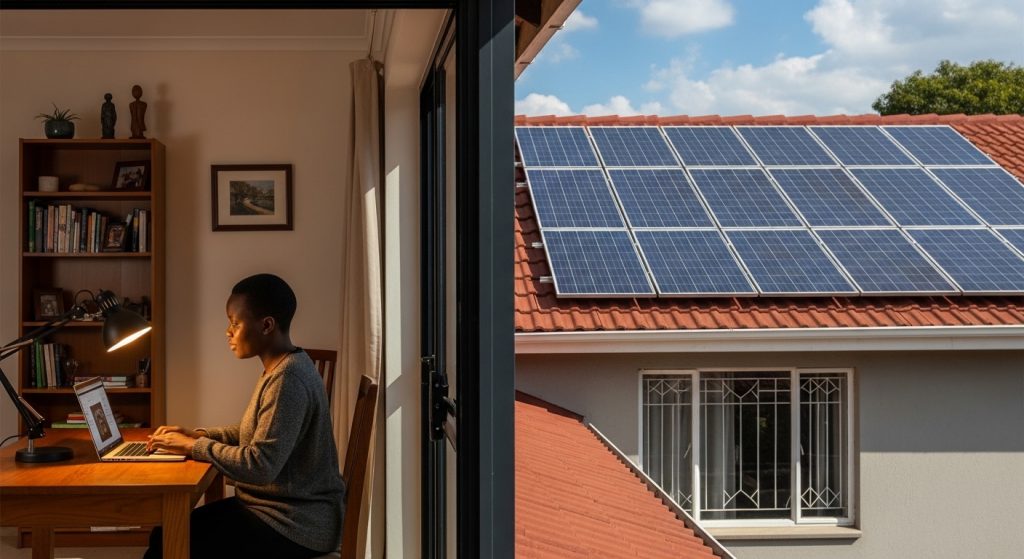
1. Step 1: Conduct a Comprehensive Energy Audit
Before buying a single solar panel, you must understand exactly how your business consumes power. Buying a solar system based on guesswork can lead to an undersized system that fails under load, or an oversized system that wastes your capital.
List Your Appliances: Walk through your business premises and list every electrical item, including energy-saving bulbs, laptops, office fans, deep freezers, and air conditioning units.
Calculate Total Wattage: Check the label on the back of each appliance to find its wattage rating. Multiply the wattage by the number of hours that appliance runs each business day to find its daily Watt-hour (Wh) consumption.
Separate Critical from Non-Critical Loads: Group your appliances. Critical loads (laptops, Wi-Fi routers, security cameras, and basic lighting) must stay powered constantly. Non-critical loads (large water heaters or heavy air conditioners) can be restricted to peak grid hours or run on a separate energy workflow.
2. Step 2: Transition to Energy-Efficient Equipment
The cheapest kilowatt-hour (kWh) of electricity is the one you do not use. Lowering your overall power demand before installing solar panels reduces the size—and the cost—of the solar system you need to buy.
Replace Incandescent Bulbs: Swap out all old bulbs for high-efficiency light-emitting diode (LED) alternatives. LEDs use up to 80% less energy and last significantly longer.
Inverter-Technology Appliances: If your business relies on refrigeration, cooling, or air conditioning, phase out old appliances and replace them with modern Inverter-technology variants. Inverter air conditioners adjust their compressor speed dynamically, cutting power consumption by nearly 40% to 50% compared to conventional units.
Enforce Smart Office Power Rules: Train your employees to turn off lights, fans, and computer monitors completely at the end of the day instead of leaving them on standby mode, which silently drains power overnight.
3. Step 3: Deploy a Modular Solar Matrix Solution
A solar matrix solution does not require disconnecting from the national grid or throwing away your existing generator immediately. Instead, it utilizes a modular, hybrid architecture that scales alongside your business cash flow.
[Solar Panels] ---> [Hybrid Inverter] <--- [National Grid / Generator]
|
v
[Lithium Battery Matrix] ---> [Business Appliances]
The Solar Panel Array (The Energy Harvest)
Install high-efficiency Monocrystalline solar panels on your building’s roof. Monocrystalline panels feature a higher efficiency rating, meaning they generate more electricity per square meter during cloudy days or low-light harmattan periods.
The Hybrid Inverter System (The Brain)
A smart hybrid inverter acts as the central control hub of your energy network. It can be programmed with automated priority rules: for example, using solar energy first during daytime hours, drawing from the grid when tariffs are low, and automatically switching to battery power during blackouts.
The Lithium Battery Matrix (The Storage Hub)
Move away from old, heavy Lead-Acid or Deep-Cycle Gel batteries. Invest instead in Lithium Iron Phosphate (LiFePO4) battery banks. While lithium batteries carry a higher upfront cost, they offer a vastly superior lifecycle (lasting 7 to 10 years), support deeper discharges without damage, and charge twice as fast.
4. Step 4: Explore Financing Options for Solar Transition
The biggest barrier to solar adoption for small businesses is the initial upfront capital cost. Fortunately, the Nigerian renewable energy ecosystem features flexible financial structures to ease the transition:
Solar Pay-As-You-Go (PAYG) / Lease-to-Own: Many solar companies allow SMEs to install equipment after a small down payment. The remaining balance is split into predictable monthly subscription payments over 12 to 24 months, matching your energy costs with your monthly operational revenue.
Power-as-a-Service (PaaS): For larger corporate offices, you can sign a Power Purchase Agreement (PPA) with a clean energy provider. They install, own, and maintain the entire solar infrastructure on your premises, and you simply pay a fixed, heavily discounted rate per kilowatt-hour for the electricity your business consumes.
Connect with Verified Solar Engineers and Suppliers
Designing a reliable solar matrix requires professional capacity load calculations, correct roof-angle orientation, and high-quality components. Buying cheap, unverified solar components or hiring untrained technicians can lead to system failures and financial loss.
If you need a certified renewable energy engineer, a solar panel distributor, or a corporate inverter maintenance expert to audit your office space, check out our directory portal.
Are you a clean energy provider, solar component importer, inverter technician, or renewable energy consultant operating in Nigeria? List your company on our online business directory today. Building a comprehensive profile with your office address, past installation photos, service warranties, and direct WhatsApp contact channels makes your brand instantly discoverable to thousands of business owners searching Google daily for trusted partners to help them cut down electricity costs.